dewystem willow
Salix irrorata · Salicaceae
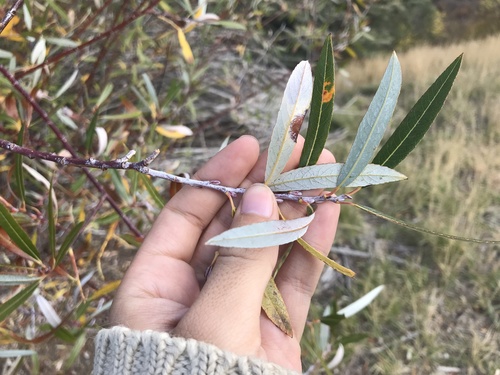
dewystem willow (Salix irrorata) is a perennial shrub in the Salicaceae family. It is native to North America. USDA records it as hardy in zone 2 and warmer, down to about -50°F.
At a glance
| Type | shrub USDA |
|---|---|
| Lifecycle | perennial USDA |
| Native status | native USDA |
| Mature height | 6 ft USDA |
| Soil pH | 5.5–7.5 USDA |
| Bloom | March–April USDA |
| Flower color | White USDA |
| Hardiness zones | 2 and warmer USDA |
| Guild layer | shrub Derived |
USDA quoted from the USDA PLANTS database · Derived computed by a fixed rule from those columns. No value on this page is estimated.
Growing conditions
Its drought tolerance is rated medium. It is recorded on soils from pH 5.5 to 7.5 — a broad range that spans acidic through mildly alkaline ground. Its cold limit is zone 2.
Size and growth
At maturity it reaches about 6 ft, making it a plant that will finish above head height.
Bloom period
USDA records a bloom period of March through April. Flowers are white.
A flowering date, not a pollinator rating.
Foliage, flower and season
Summer foliage is green, coarse in texture. Its flowers are not conspicuous — a plant for form and foliage. It carries conspicuous autumn colour. USDA rates its lifespan as short, so plan on replacing or resowing it rather than treating it as permanent structure.
What the site needs to provide
USDA records it across sites receiving 12 to 40 inches of annual precipitation. The low end of that band is genuinely arid, so it has a wide tolerance for dry country. It needs at least 110 frost-free days to finish its season. It roots to at least 24 inches.
Propagating it
Cuttings is the only propagation method USDA lists. Its seed spreads at a rapid rate.
Resilience and wildlife
Its growth form is recorded as thicket forming.
Role in a guild
Shrub layer. In a layered planting this is woody mid-level structure between the understory and the ground. The layer is derived by a fixed rule from growth habit and mature height.
Tags
Related plants
Others in Salix
- feltleaf willow Salix alaxensis
- white willow Salix alba
- peachleaf willow Salix amygdaloides
- littletree willow Salix arbusculoides
Similar role and hardiness
- speckled alder Alnus incana
- Sitka alder Alnus viridis
- beaked hazelnut Corylus cornuta
- gray dogwood Cornus racemosa
- black hawthorn Crataegus douglasii
Where this data comes from
Every value on this page comes from the USDA PLANTS database record for symbol SAIR, or is computed from those values by a fixed rule. Nothing here is estimated or model-generated. Where USDA publishes no value, this page omits the claim rather than filling the gap.
- Quoted from USDA PLANTS: Bloom, Bloom end, cold stratification, Drought tolerance, fall conspicuous, Flower color, flower conspicuous, foliage color, foliage porosity winter, foliage texture, frost free days min, fruit conspicuous, growth form, Hardiness zones, Lifecycle, lifespan, Mature height, Minimum temperature, Native status, Nitrogen fixation, precipitation max in, precipitation min in, propagation, resprout ability, root depth in, seed spread rate, Soil pH, Soil pH (upper), Tolerance of wet soil, Toxicity, Type.
- Derived by a fixed rule from those columns: Guild layer.
Read our full data sources and methodology.
Find more plants for your zone with the Plant Finder.