horsetail paspalum
Paspalum fluitans · Poaceae
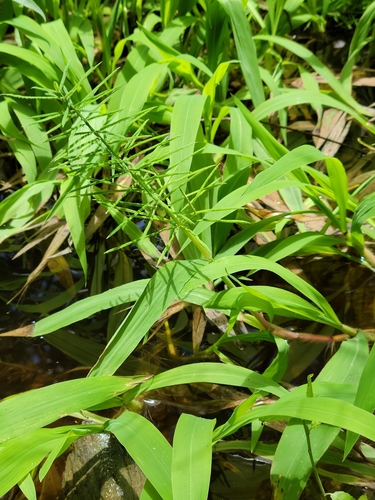
horsetail paspalum (Paspalum fluitans) is a annual grass or grass-like plant in the Poaceae family. It is native to North America. USDA records it as hardy in zone 4 and warmer, down to about -23°F.
At a glance
| Type | graminoid USDA |
|---|---|
| Lifecycle | annual USDA |
| Native status | native USDA |
| Mature height | 2.5 ft USDA |
| Light | part-shade USDA |
| Water need | high USDA |
| Growth rate | rapid USDA |
| Soil pH | 6–8.6 USDA |
| Bloom | August–September USDA |
| Flower color | Green USDA |
| Hardiness zones | 4 and warmer USDA |
| Guild layer | herb-layer Derived |
| Nursery availability | No Known Source USDA |
USDA quoted from the USDA PLANTS database · Derived computed by a fixed rule from those columns. No value on this page is estimated.
Growing conditions
It grows in partial shade. USDA rates it as having needs consistently moist ground. Its drought tolerance is rated none — it needs reliable moisture. It tolerates saturated, poorly drained ground well (USDA rates its anaerobic tolerance high). It is recorded on soils from pH 6 to 8.6 — a broad range that spans acidic through mildly alkaline ground. Its cold limit is zone 4.
Size and growth
At maturity it reaches about 2.5 ft, making it about knee height. It grows quickly.
Bloom period
USDA records a bloom period of August through September. Flowers are green.
A flowering date, not a pollinator rating.
Foliage, flower and season
Summer foliage is gray-green, fine in texture. Its flowers are not conspicuous — a plant for form and foliage. Its active growth period is spring and summer.
What the site needs to provide
USDA records it across sites receiving 40 to 64 inches of annual precipitation. It needs at least 190 frost-free days to finish its season. It roots to at least 4 inches. Fertility requirement: medium.
Propagating it
Propagate it from seed and sprigs. USDA records no cold-stratification requirement, so seed should germinate without a chilling period. Its seed spreads at a rapid rate. It spreads vegetatively at a moderate rate.
Resilience and wildlife
Browsing animals find it highly palatable, so expect deer and rabbits to take an interest. Its growth form is recorded as stoloniferous.
Role in a guild
Herb layer. In a layered planting this is the herbaceous middle — perennials and grasses that fill the space between ground cover and shrubs. The layer is derived by a fixed rule from growth habit and mature height.
Tags
Related plants
Others in Paspalum
- hilograss Paspalum conjugatum
- longtom Paspalum denticulatum
- dallisgrass Paspalum dilatatum
- knotgrass Paspalum distichum
Similar role and hardiness
- common oat Avena sativa
- Caucasian bluestem Bothriochloa bladhii
- black grama Bouteloua eriopoda
- cosmopolitan bulrush Bolboschoenus maritimus
- Carolina fanwort Cabomba caroliniana
Where this data comes from
Every value on this page comes from the USDA PLANTS database record for symbol PAFL5, or is computed from those values by a fixed rule. Nothing here is estimated or model-generated. Where USDA publishes no value, this page omits the claim rather than filling the gap.
- Quoted from USDA PLANTS: active growth period, Bloom, Bloom end, browse palatability, cold stratification, Drought tolerance, fall conspicuous, fertility requirement, Flower color, flower conspicuous, foliage color, foliage porosity winter, foliage texture, frost free days min, fruit conspicuous, growth form, Growth rate, Hardiness zones, Lifecycle, Light, Mature height, Minimum temperature, Native status, Nitrogen fixation, Nursery availability, precipitation max in, precipitation min in, propagation, resprout ability, root depth in, seed spread rate, Soil pH, Soil pH (upper), Tolerance of wet soil, Toxicity, Type, vegetative spread rate, Water need.
- Derived by a fixed rule from those columns: Guild layer.
Read our full data sources and methodology.
Find more plants for your zone with the Plant Finder.